

From Viking sails to English swords, Paris has spent centuries fortifying its beauty against the world.
Over 400 years before King Louis XIV of France built Versailles as a home for his own pomposity and grandiose ceremonies, French King Philip II left to lead the Third Crusade to reclaim Jerusalem alongside Richard I of England and Roman Emperor Barbarossa. Prior to leaving, he ordered that a wall be built around his capital – Paris – to protect it from attacks by the English who held Normandy at the time. He and his people knew well of the Viking Tale of Ragnarr Loðbrók and his potential role in the 845 Siege of Paris. They didn’t want its narrative repeated. This wall, which began construction in roughly 1190 on the right bank of the Seine, became known as the Wall of Philip II Augustus.
Paris quickly outgrew its walls. By the mid-1300s, Charles V – called Charles the Wise – expanded the city so far beyond Philip’s walls that the old fortifications became part of the royal domain itself. By the mid- to late 1600s, King Louis XIV was seeking to cast himself as the ‘radiant’ center of France’s political and cultural universe. Much as the sun is the centre of the cosmos, he declared himself the Sun King – le Roi Soleil.
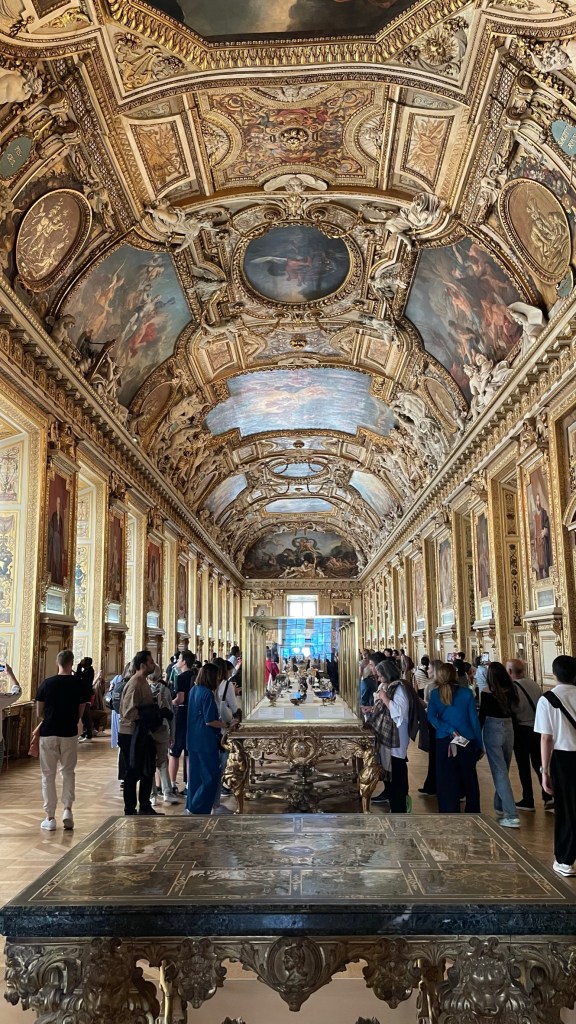
Louis XIV’s first, tangible demonstration of his becoming le Roi Soliel was to build a gallery to replace his grandfather’s Petite Galerie; destroyed by fire in 1661. Designed and built by those artists, painters and sculptors who would go on to build the Hall of Mirrors at Louis XIV’s new residence, Versailles. The ‘Gallery of Apollo’s’ lavishness “gave visual form to the sun’s power over the whole universe”1 which, in turn, magnified the glory of le Roi Soliel.
This past Wednesday, the former residence of Louis XIV prior to Versailles – now known as the Louvre – re-opened its doors to the public. The Louvre is one of the largest and most visited museums in the world, with a collection spanning ancient to 19th-century art, and houses major works like the Mona Lisa, the Venus de Milo and the Winged Victory of Samothrace.
As news trickled out, the details felt like folklore retold for the 21st century. In broad daylight, thieves in fluorescent vests and hard hats entered the Louvre under the guise of maintenance workers. While visitors milled about, they cordoned off a section of the gallery, executed their plan with unnerving calm, and vanished into the Parisian streets with the Crown Jewels in tow. No smoke, no battering rams – just the choreography of precision.
If the 845 siege was a clash of steel and blood, this was its echo rendered in high-visibility fabric and counterfeit work orders. A second Siege of Paris, this time fought not by Vikings, but by men wielding clipboards and cunning.
All the galleries reopened to the public on Wednesday – except one. The Galerie d’Apollon remained sealed, its golden light cut off from the crowds. The reason? Robbery.
More than $100 million US dollars worth of The French Crown Jewels, on display since 1887, were taken in what could only be described as a significant analogue action.
Historical and contemporary details were drawn from materials published by the Louvre Museum, Global News, CNN, CBC, TIME, BBC, and The French History Podcast, alongside verified accounts of the 845 Siege of Paris. Additional context from museum archives and open historical sources helped illuminate the through-line from Philip II’s walls to Louis XIV’s Galerie d’Apollon and the modern-day “analogue action.”
 The Analogue Press
Leave a comment